Read the night: essential lights and shapes
Navigation lights form a visual language. They help you infer a vessel’s aspect, direction and activity—but only when you observe the complete pattern.
- Connect red with port, green with starboard and white with fore/aft sectors.
- Use visible colours to form a cautious first interpretation.
- Explain why one light alone cannot assign responsibilities.
Colour reveals the side you can see
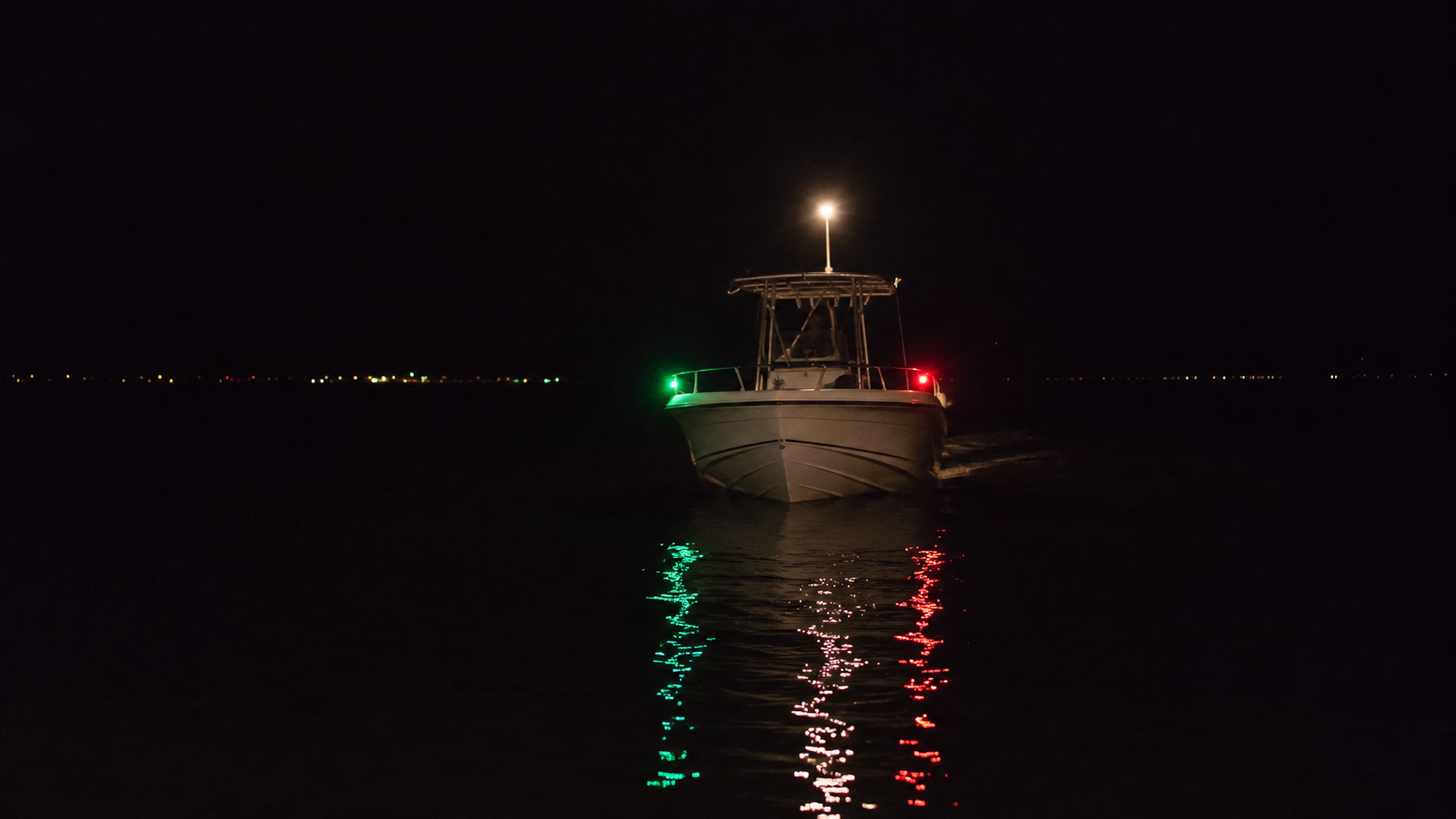
Marks the vessel’s port side over a forward sector.
Marks the starboard side over a forward sector.
Shown by power-driven vessels underway over a forward sector; exact arrangements vary.
Shows aft. White can have other meanings, so read the whole pattern.
Reuse the Lesson 1 anchors
Port—the drink—is red. Port and left both have four letters. The other sidelight is green on starboard. Both red and green suggest you are looking toward the bow; red plus an appropriate white suggests the port aspect, while green plus white suggests starboard.
red▲bowSTARBOARD
greenWHITE ASTERN
Build meaning in three passes
Which colours, how many, and how are they arranged?
Which side might you see, and is the bearing changing?
Could the pattern indicate sailing, towing, fishing, restriction or anchoring?
Observe longer, use all means and apply the correct rules.
You see red and white
Your first hypothesis is the other vessel’s port aspect. Test it: is the pattern complete, what are bearing and range doing, and are other lights visible? Never declare stand-on or give-way from two colours alone.
Check your understanding
1. You see red and green sidelights. Which aspect?
2. Does one white light always mean a sternlight?
3. When are prescribed lights shown?
Dockside light walkaround
- Safely identify each installed light.
- State colour and intended sector.
- Check for damage or obstruction.
- Predict the view from ahead, abeam and astern.
Colour gives aspect; the complete pattern gives meaning. Observe, hypothesise and verify.